Cybertruck Winter Tire Range Test at 70 MPH
Factory All-terrains: 503Wh/mi
Duratrac Wrangler Winter tires: 535Wh/mi
Total Range Loss: 8%
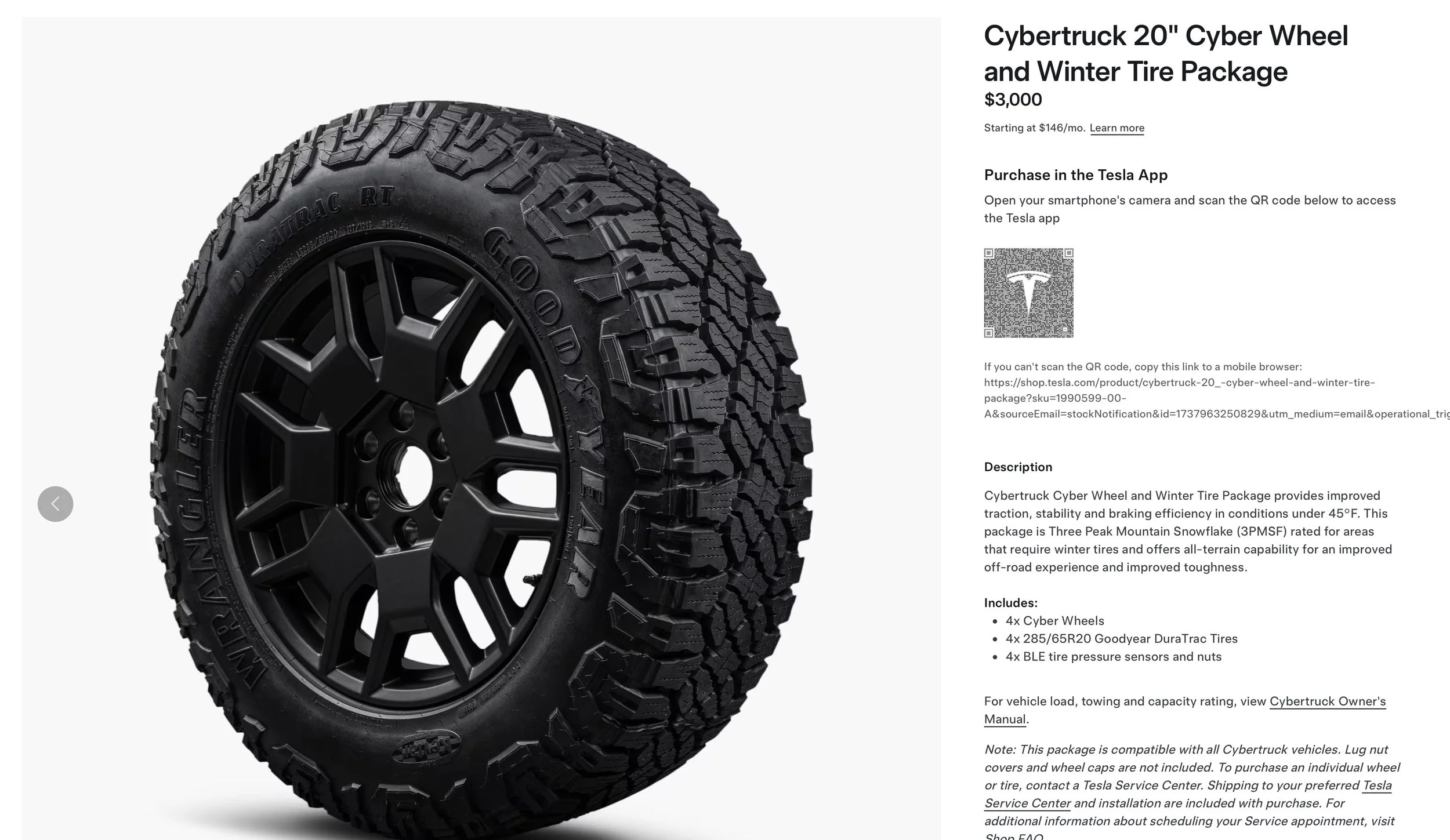
Tesla’s Duratrac Wrangler Winter Tire Option
Cybertruck owners in cold-weather states face a familiar winter decision: prioritize maximum traction or preserve highway range. Winter tires dramatically improve control in snow and ice, but they also change how efficiently the Cybertruck moves down the road. This guide breaks down a controlled 70 mph highway range test comparing the factory all-terrain tires to Tesla’s official winter tire setup using real-world data and repeatable methodology.
If you drive your Cybertruck year-round in places like Minnesota, North Dakota, Michigan, or Alaska, this is the kind of information that matters more than EPA estimates. The focus here is steady-speed interstate driving, where rolling resistance and tire design have an outsized impact on Wh/mi and total range.
At-a-Glance: Key Test Results (70 MPH Highway)
Speed: Locked 70 mph highway driving
Route: ~36-mile out-and-back interstate loop
Ambient Temperature: ~48°F
Accessories Installed: Roof rack, rooftop tent, light bar (unchanged)
Factory All-Terrain Tires
503 Wh/mi average
~36.1 miles recorded
Lower rolling resistance
Tesla Winter Tires
535 Wh/mi average
~36 miles recorded (measured slightly longer due to tire diameter)
Higher rolling resistance
Real-World Difference
~8% increase in Wh/mi at 70 mph
~15–20 miles of highway range lost on a full charge in this configuration
Tire Technical Overview: What’s Being Compared
Factory Cybertruck All-Terrain Tires
Tesla Cybertruck Factory Original Goodyear Wrangler Territory RT Tire:
LT285/65R20 — this is the stock all-terrain tire size used on Cybertruck 20″ wheels. It has an overall nominal diameter of about 34.6–34.9″ and a width of roughly 11.2″
Cybertruck’s factory all-terrain tires are designed as a balanced, all-season solution for mixed on-road and light off-road use. They feature a moderately aggressive tread pattern optimized to work with the Cybertruck’s aero wheel covers, helping reduce turbulence at highway speeds.
From a technical standpoint, these tires prioritize lower rolling resistance and consistent tread block contact, which directly benefits highway efficiency. In dry and wet conditions, they perform well, but snow and ice traction is limited, particularly during acceleration and braking. For owners in northern states, these tires often become the limiting factor in winter drivability rather than range.
Tesla 2025 Official Winter Tires (Goodyear Duratrac RT-Based)
Cybertruck Winter Tires:
285/65R20 Cybertruck Goodyear DuraTrac RT tires — this is the tire size and official model name Tesla lists for the winter-rated Goodyear Duratrac option in the Cybertruck winter tire and wheel package, mounted on 20″ cyber wheels.
Tesla’s official winter tire setup for the Cybertruck uses a much more aggressive winter-focused tread design, similar in construction and behavior to the Goodyear Duratrac RT. These tires use deeper tread blocks, increased siping, and a rubber compound designed to remain flexible in cold temperatures.
Technically, this design increases rolling resistance by design. The softer compound and aggressive tread improve snow and ice traction but require more energy to maintain speed, especially at highway velocities. Although labeled as the same nominal size as the factory tires, these winter tires have a slightly smaller effective rolling diameter—about 1.6% smaller—which affects distance calculations and compounds the apparent efficiency loss.
Test Conditions and Methodology
This test was designed to isolate tire impact as cleanly as possible. The Cybertruck’s configuration remained unchanged between runs, including the roof rack, rooftop tent, Starlink setup, and exterior lighting. Aero covers were removed to ensure a true tire-to-tire comparison.
The route consisted of an out-and-back interstate drive at a locked 70 mph using cruise control. This method helps neutralize wind effects, as any headwind on the outbound leg becomes a tailwind on the return. Cabin HVAC was set to 68°F, accessory power was disabled, and driving inputs were kept consistent.
While 48°F is not deep-winter cold, it reflects realistic early-winter and late-fall conditions common across the Upper Midwest.
WINTER TIRE EFFICIENCY TEST RESULTS
Factory All-Terrain Results at 70 MPH
-> 503Wh/mi on Factory All-Terrains
With the factory all-terrain tires installed, the Cybertruck averaged 503 Wh/mi over 36.1 miles of highway driving at 70 mph . Given the added aerodynamic drag from the roof rack and tent, this is solid real-world efficiency for a full-size electric truck.
At this consumption level, highway range estimates land around 230 miles on a full charge in this configuration. Owners without roof-mounted accessories typically see significantly better numbers, often in the low-400 Wh/mi range under similar conditions.
Cabin noise measured roughly 67 dB at speed, confirming that wind noise—not tire noise—is the dominant factor at highway velocities.
Winter Tire Results and Efficiency Impact at 70 mph
-> 535Wh/mi on Winter Tires
After switching to the winter tire setup, average energy consumption increased to 535 Wh/mi over nearly the same route and driving profile. Tire noise increased noticeably, though total cabin noise remained at 67dB due to wind masking most of the difference.
The smaller rolling diameter of the winter tires caused the Cybertruck to calculate slightly more distance traveled, which further inflated the Wh/mi reading. When corrected for this effect, the true efficiency penalty still lands close to 8%, aligning with expectations for aggressive winter tires on a heavy EV.
Total Range Loss: 8%
What This Means for Cold-Weather Cybertruck Owners
An 8% increase in Wh/mi at highway speed is a meaningful but manageable tradeoff for winter capability. For Cybertruck owners in wintery areas, winter tires dramatically improve traction, braking, and overall control—benefits that far outweigh the modest range reduction.
The key takeaway is predictability. Knowing your winter Wh/mi allows you to plan charging stops more accurately and avoid surprises on long interstate drives. Combined with cold temperatures and headwinds, winter tires do reduce range, but the impact is far from catastrophic.
For most owners, this data confirms what experience already suggests: winter tires are worth it, and the Cybertruck remains fully usable year-round with proper planning.